
Bangs on Fine Hair
What to Know Before You Cut (and If You Already Have Them)
Cutting bangs isn’t a small decision, especially if you have fine hair.
Bangs can take years to fully grow out. During that time, they don’t just change how your hair looks; they change how your haircut behaves. They affect shape, fullness, balance, and how your bob holds its structure.
Before you cut them, it’s worth understanding what bangs actually cost in terms of perimeter and structure, what they change, and why so many women with fine hair eventually choose to grow them out.
This guide exists so you can decide with confidence, not impulse.
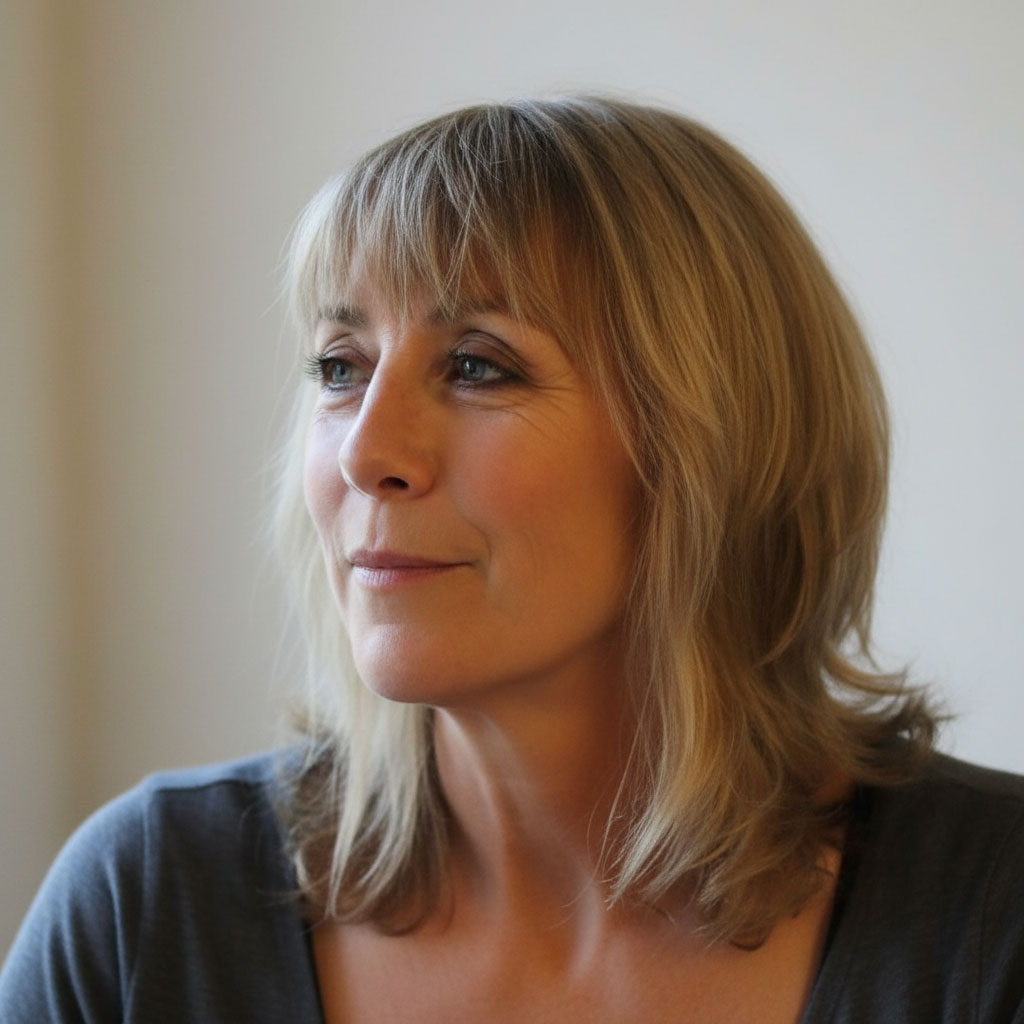
Years of bangs. Well over a year growing it out. Everything I learned about fine hair structure started here.
Why Bangs Are a Bigger Decision for Fine Hair
Fine hair isn’t just “less hair.” It has different physics.
Each strand is smaller in diameter, which means:
• It creates less visual weight
• It collapses more easily
• It shows imbalance faster
• It relies heavily on its outline for fullness
That outline, the perimeter of your haircut, is what gives fine hair its shape and presence.
And that perimeter is exactly where bangs come from.
Where Bangs Actually Come From
Bangs don’t appear out of nowhere.
They are cut from:
• The front perimeter
• The temple zones
• The front sides of your haircut
These are the areas where fine hair is already at its most delicate.
They are also the areas that:
• Frame the face
• Create visual density
• Hold a bob together
• Prevent see-through edges
So when bangs are added, hair is not being added, it’s being redistributed.
This also changes direction. Hair that once fell downward to support the outline is redirected forward across the forehead. Fine hair depends on consistent fall patterns to maintain shape, so this shift often weakens how the rest of the haircut sits.
That redistribution matters.
What Bangs Change Structurally
This isn’t about whether bangs look “cute.”
It’s about what they do.
Bangs reduce the available density that supports the perimeter and corners of the haircut. On medium or thick hair this loss can be absorbed. On fine hair, it is immediately visible.
On fine hair, bangs often reduce:
• Perimeter thickness
• Visual fullness at the sides
• Corner strength
• Outline clarity
This is why many women with fine hair say:
“My bob looked better before I got bangs.”
They’re not imagining it.
The structure really did change.
Why Bangs Often Look Good at First – Then Worse Over Time
Bangs usually look their best:
• Freshly cut
• Carefully styled
• Placed just right
But hair doesn’t stay frozen.
As bangs grow:
• They lose their shape
• They interrupt the outline
• They create awkward lengths
• They require constant styling
• They weaken the haircut’s balance
Fine hair reveals imbalance quickly. As the fringe length changes, it alters how weight is distributed at the front. Fine hair cannot easily re-balance itself, so the cut loses harmony faster than it would on denser hair. What looks charming at week one can feel frustrating by month two.
This isn’t personal. It’s structural.
A Practical Note: Glasses and Bangs
If you wear glasses, bangs can require a little more daily management. The frames often sit exactly where fine hair is most sensitive to movement, which can cause fringe to flip outward, separate, or lose its shape more easily.
This doesn’t mean bangs won’t work. It simply means they may require more frequent styling and adjustment.
For women who prefer very low-maintenance hair, this is worth considering.
On fine hair, even small shifts at the front are more visible.
The Long-Term Reality of Growing Bangs Out
Once bangs are cut, they don’t disappear.
They must grow through:
• Fringe length
• Eye length
• Cheekbone length
• Jaw length
• Collarbone length
At every stage, they affect how the rest of your haircut behaves.
For many women, this process takes 18 months or more dependent upon growth rate.
That’s why bangs aren’t a casual experiment for fine hair.
They’re a long-term commitment.
Facial Proportions Matter
Bangs don’t just interact with hair. They interact with face shape.
For some women, especially those with longer or more open foreheads, bangs can:
• Shorten the vertical face line
• Rebalance proportions
• Bring focus to the eyes
In those cases, bangs can feel transformational.
But that proportional benefit does not cancel out the structural cost for fine hair.
So the real decision becomes a trade-off:
Facial balance vs. hair fullness
Neither is wrong. But both deserve to be understood.
Why What You See Online Isn’t Always Real Life
Many of the fine-haired styles we admire publicly are created with professional support.
This can include:
• Extensions
• Fillers
• Density-enhancing techniques
• Strategic styling
• Controlled lighting
This is simply how visual industries work.
But it does change what’s possible.
When you’re working with your natural fine hair only, the physics are different.
That’s why it’s so valuable when women share what their real fine hair actually looks like, not as a comparison, but as a point of truth.
Why Expectations Are So Distorted
We live in a world that quietly equates volume with “better.”
That bias shows up everywhere – advertising, styling trends, and even AI-generated images. Ask for fine hair, and the result is often fuller, denser, and more lifted than reality.
It’s not malicious. It’s cultural.
But it does shape what women believe their hair should look like.
Fine hair isn’t failing.
It’s simply being measured against a template it was never meant to match.
MyBobette exists to bring the focus back to what fine hair actually is and what works with it.
When Bangs Can Work on Fine Hair
This is not an anti-bangs manifesto.
Some fringe styles are simply more forgiving than others.
In general:
• Longer curtain bangs are lower risk
• Soft, blended face-framing is gentler
• Heavy blunt bangs require more density
• Micro-fringes are often the most unforgiving
The perimeter must remain strong.
Bangs that preserve corner strength and do not remove excessive front density are more compatible with fine hair. The key is minimizing disruption to the outline.
It’s not about trends.
It’s about structure.
Signs Bangs May Be Undermining Your Haircut
If you’ve been thinking:
• “My sides look thinner”
• “My bob lost its shape”
• “My hair feels flatter”
• “It looked good at first, now it doesn’t”
• “It’s harder to style”
There is likely a structural reason.
Not a personal one.
If You’re Thinking of Growing Them Out
You’re not alone.
Many fine-haired women eventually choose to grow their bangs out, not because they failed, but because they learned.
As bangs grow out, many women notice:
• Stronger perimeter
• Fuller sides
• More stable shape
• Easier styling
• Less daily effort
And often, more peace.
What Fine Hair Actually Deserves
Every hair type has its own structure, behavior, and beauty.
The problem isn’t fine hair.
The problem is being taught to measure it against a template it was never meant to match.
When you understand your hair, how it grows, how it behaves, what it needs, you stop fighting it.
That’s freedom.
How to Decide Without Regret
Before cutting bangs, ask:
• Am I choosing this for proportion, or for trend?
• Do I understand what hair I’m giving up?
• Am I okay with the long-term commitment?
• Am I working with my structure, or against it?
There is no right answer.
Only informed ones.
On fine hair, the decision to cut bangs is not just a style choice.
It is a structural reallocation of material.
The MyBobette Philosophy
All hair is beautiful.
But fine hair is rarely shown honestly and in its natural beauty.
The MyBobette Method™ exists to change that.