
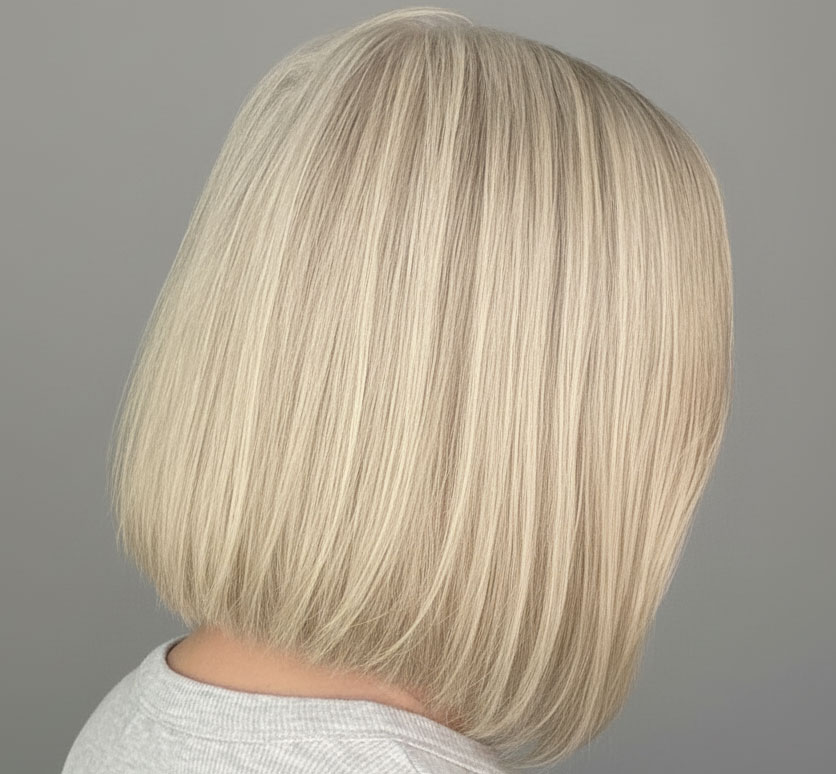
Fine hair with an intact perimeter on second day hair, showing how a clean outline reflects light and holds shape beyond wash day.
Fine Hair Damage
How to Protect Your Perimeter and Keep Your Bob Strong
For a long time I thought the damage I was seeing in my fine hair was just ageing. Ends that frayed quickly, a perimeter that lost its shape within days, a bob that looked good one morning and flat by afternoon. It wasn’t age. It was accumulated stress I hadn’t recognised as damage because it happened gradually rather than all at once.
Fine hair reveals every detail, especially at the ends. Where thicker hair can hide wear, fine hair shows it quickly and clearly.
This guide explains what fine hair damage actually looks like, why it happens, and how to prevent the slow thinning and collapse that so many women mistake for “just how my hair is.”
You’ll learn how to protect your perimeter, reduce unnecessary stress on your strands, and keep your bob looking clean, defined and intentional over time.
Because fine hair doesn’t need more products.
It needs less damage and better structure.
Why Fine Hair Shows Damage Faster
Fine hair has less internal mass and fewer structural layers within each strand. This means the cuticle has less reinforcement. When stress occurs, the strand weakens faster, and the perimeter loses its sharp outline sooner than on thicker hair.
Fine strands:
-
are lighter
-
have fewer layers
-
bend easily
-
fray quickly
-
cannot hide breakage
Where medium or thick hair disguises roughness, fine hair magnifies it.
The good news?
Fine hair responds quickly when treated with intention.
What Fine Hair Damage Actually Looks Like
As ends weaken, natural growth direction becomes harder to control, which is why damaged fine hair often flips, separates, or won’t sit smoothly.
You’ll notice:
-
Ends look soft, not sharp
-
Perimeter looks feathery or cloudy
-
Hair tangles more than usual
-
The outline collapses within days
-
The last inch looks dull
-
Breakage shows up as “frizz”
-
Hair lacks its usual clean shape
These aren’t personal flaws.
They’re signs your hair needs structure, not stress.
The Root Causes of Fine Hair Damage
Fine hair becomes compromised mostly from:
Thinning shears
Thinning too much removes structure, leading to rapid collapse.
Heavy heat
Weakens cuticle → dull, fragile ends.
Harsh coloring
Creates dryness → leads to trimming → leads to density loss.
Too many products
Weighs the hair down → flattens the perimeter.
Aggressive brushing
Snaps delicate ends → weakens outline.
Cutting too much, too often to “fix” dry ends
Removes density → bob appears smaller.
None of this means your hair is weak.
It’s simply responsive, which is a strength once you understand it.
The Color Loop: The Cycle That Steals Density
I went through the color loop myself for longer than I care to admit. Coloring for grip, trimming the dryness, losing density, coloring again. The loop only broke when I stopped trying to fix the symptom and started protecting the structure instead.
Many fine-haired women are stuck in this pattern:
1. Color for grip or fullness
2. Ends dry out
3. Trim the damage
4. Lose density
5. Color again for grip
6. More dryness
7. More trimming
8. Less density
It’s an exhausting loop.
And completely avoidable.
My own hair is a good example of this. I stopped coloring years ago and what grew in is naturally grey-blonde – some days it reads more silver, other days warmer and closer to blonde depending on light, what I’m wearing, and whether I’ve used a brightening shampoo recently.
What I gained when I stopped the color loop was density, condition, and a perimeter that finally held its shape consistently. The trade felt straightforward once I understood what the loop was actually costing me.
How to break the loop:
- Let natural color grow in if possible
-
If coloring, choose toning, glazing, or root blending over full chemical processes
-
Protect your perimeter religiously
-
Space color appointments farther apart
-
Keep trims small and intentional
Your hair often appears stronger once stress is reduced.
Why the Perimeter Matters More Than Anything
On fine hair, the perimeter is also the main weight line. When the ends become frayed or over-trimmed, that weight line thins, and the haircut loses its ability to hold shape.
The perimeter is the outline, the first thing the eye sees.
A strong perimeter:
-
makes hair appear thicker
-
gives structure to fine strands
-
reduces tangles
-
grows well
-
holds shape
A weak perimeter:
-
collapses
-
frays
-
requires daily fixing
-
looks thin
-
loses polish
The MyBobette Method™ was created:
To protect and maintain this perimeter at home.
How to Prevent Damage and Keep Your Bob Line Clean
Gentle shampoo
Prevents buildup that weighs down fine strands.
Conditioner only on ends
Avoid the roots.
Micro-trims
Small, regular, structure-preserving.
Reduce heat
Fine hair sets when cooling, not heating.
Silk or satin pillowcases
Reduce friction. Cotton creates friction.
Use a feathering razor only for micro trims and controlled shaping
Not for removing bulk.
Soft detangling
A wide-tooth comb, never harsh brushing.
These tiny choices give dramatic results.
How to Recover from Existing Damage
Fine hair often improves quickly when treated well.
Fine hair responds faster than most people expect once the stress is reduced. These are the changes that made the most difference for me:
- Avoid heat tools
- Use velcro rollers instead of heat
- Gently detangle, never yank
- Reduce coloring
- Keep the perimeter blunt
- Use micro-trims only
You will see:
-
sharper outline
-
stronger ends
-
smoother styling
-
instant visual density
Fine hair thrives on consistency, not complexity.
In Summary
Fine hair isn’t weak, it’s simply honest.
Because fine hair relies more on perimeter strength than internal density, small amounts of damage change the haircut’s behavior more dramatically than on thicker hair types.
It shows stress quickly,
shows improvement quickly,
and rewards the right method quickly.
Protect the perimeter, honour the structure, and your bob becomes effortless.